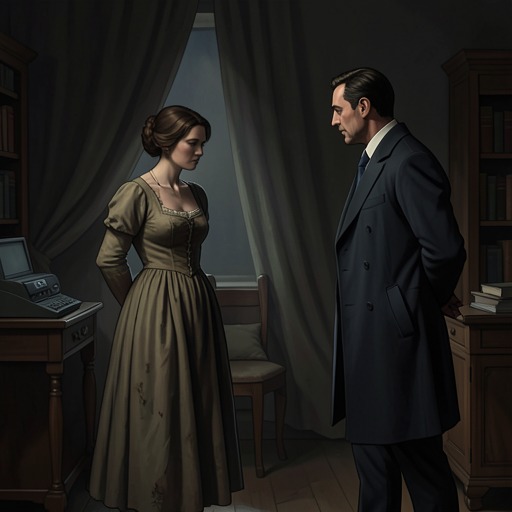
Casaubon meets Lia
Foucault's PendulumCasaubon meets Lia in a nearly deserted Milan library on July 16, 1981, and their brief quarrel over a reference volume opens into a relationship that joins intellectual companionship to domestic life. The encounter gives Casaubon not only a partner but a sharper collaborator: Lia checks encyclopedia entries, follows clues more capably than he does, and suggests connections, even as their shared investigations draw her toward the material he later hopes to keep her and their child away from.
The Library Encounter
The meeting takes place as Milan is emptying for the summer and the library’s reference room stands almost deserted. Lia wants volume 109, which Casaubon has left at his seat while checking a note. Their exchange is brisk and mildly reproachful: she asks why he left the volume there, and he offers his brief absence as an excuse. She takes the book stubbornly and returns to her table; Casaubon sits opposite her, trying to see her face.
His attempt to make conversation begins with an observation about the way she reads. He asks how she can manage unless the text is in Braille. Lia answers that she can see perfectly well, though at first Casaubon cannot tell whether he is looking at her face or the nape of her neck. When she lifts her hair, he sees her green eyes. The encounter’s decisive turn is understated: after a few more words, Casaubon identifies this as the beginning of their relationship.
From Conversation to Intimacy
Their connection develops quickly outside the library. At supper, Lia tells Casaubon to eat because he is thin; by midnight they are still talking in a Greek restaurant near Pilade’s, with a candle guttering in the neck of the bottle. They tell each other everything. The closeness is emotional and intellectual at once: Lia and Casaubon do almost the same kind of work, checking encyclopedia entries.
Casaubon feels compelled to tell her about himself. At twelve-thirty, as Lia moves her hair aside to see him better, he points a finger at her, raises his thumb, and says, “Pow.” Lia replies, “Me too.” Their exchange turns the earlier playful gesture into a shared declaration. That night they become lovers, and from then on Lia calls him Pow, a private name that carries their first moment of mutual recognition into the life they build together.
A Shared Life and Shared Work
The relationship takes shape under practical constraints: they cannot afford a new house. Casaubon sleeps at Lia’s place; at other times, she stays with him at the office. Their arrangement is flexible rather than settled in a separate home, and their working lives remain close to their domestic one. Lia sometimes goes out investigating, not as a passive companion but as an active contributor to Casaubon’s research.
Casaubon acknowledges that she is better than he is at following up clues. She is also good at proposing connections, the very operation on which his later habit of assembling patterns depends. Her competence gives their partnership an intellectual dimension that is distinct from their intimacy: she can pursue evidence and see possible links for herself, rather than simply receive his conclusions. Their shared file on the Rosicrucians, including notes Casaubon had taken in Brazil, offers one concrete point where their joint work intersects with the occult material that occupies him.
Relationship and Narrative Significance
The scene begins with ordinary research-room friction, not a dramatic revelation. A borrowed volume, a misread face, and a teasing question about Braille provide the modest circumstances from which a lasting bond grows. The shift from a library table to a late supper, and from confession to the word “Pow,” gives the relationship a compressed but legible progression: curiosity becomes conversation, conversation becomes trust, and trust becomes shared life.
Lia’s significance to Casaubon is established through more than affection. She offers practical companionship, intellectual equality in their encyclopedia work, and a stronger investigative instinct. That closeness later makes his wish to keep her and their child outside his dangerous business especially telling: the relationship begins in shared inquiry, but Casaubon eventually imagines protecting them by excluding them. The account of how they met therefore establishes both the intimacy he depends on and the boundary he will try to draw around the Plan.